Better project economics from the same solar and battery system
An anonymised Queensland commercial project used AmpauraDesigner to compare solar and battery options and model a more attractive operating strategy before deployment.
- 15.2%
- Shorter projected payback
- 7 years
- Projected payback with AI optimisation
- vs 8.25 years without AI
- 57.9%
- Projected energy independence
Challenge
Balance stronger returns with higher energy independence.
The project considered a future-load scenario of about twice the current level. The owner wanted stronger energy independence within an acceptable payback range. A smaller system projected a quicker payback, but lower energy independence, so the shortest payback alone was not the right selection criterion.
Approach
Turn project inputs into comparable investment cases, faster.
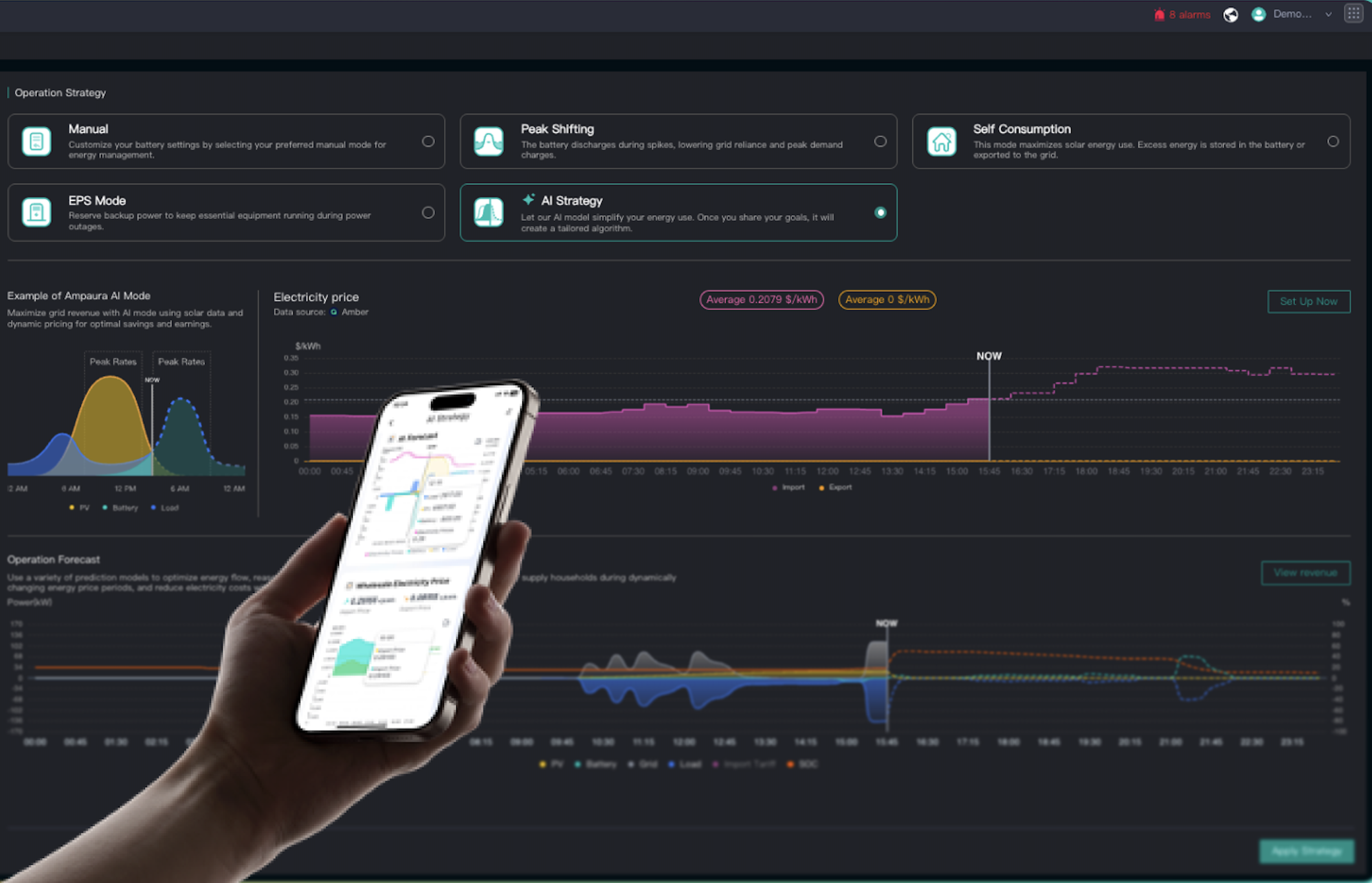
AmpauraDesigner used automated modelling to bring the available load, tariff, equipment and financial assumptions into one project case. It compared system choices against the same objectives, then tested an AI operating strategy for the selected hardware.
- Understand — Organise site inputs and constraints in one project model.
- Compare — Assess configurations against return and energy-independence goals.
- Optimise — Model the selected system with a different operating strategy, without changing its hardware.
Results
A stronger investment case without changing the selected hardware.
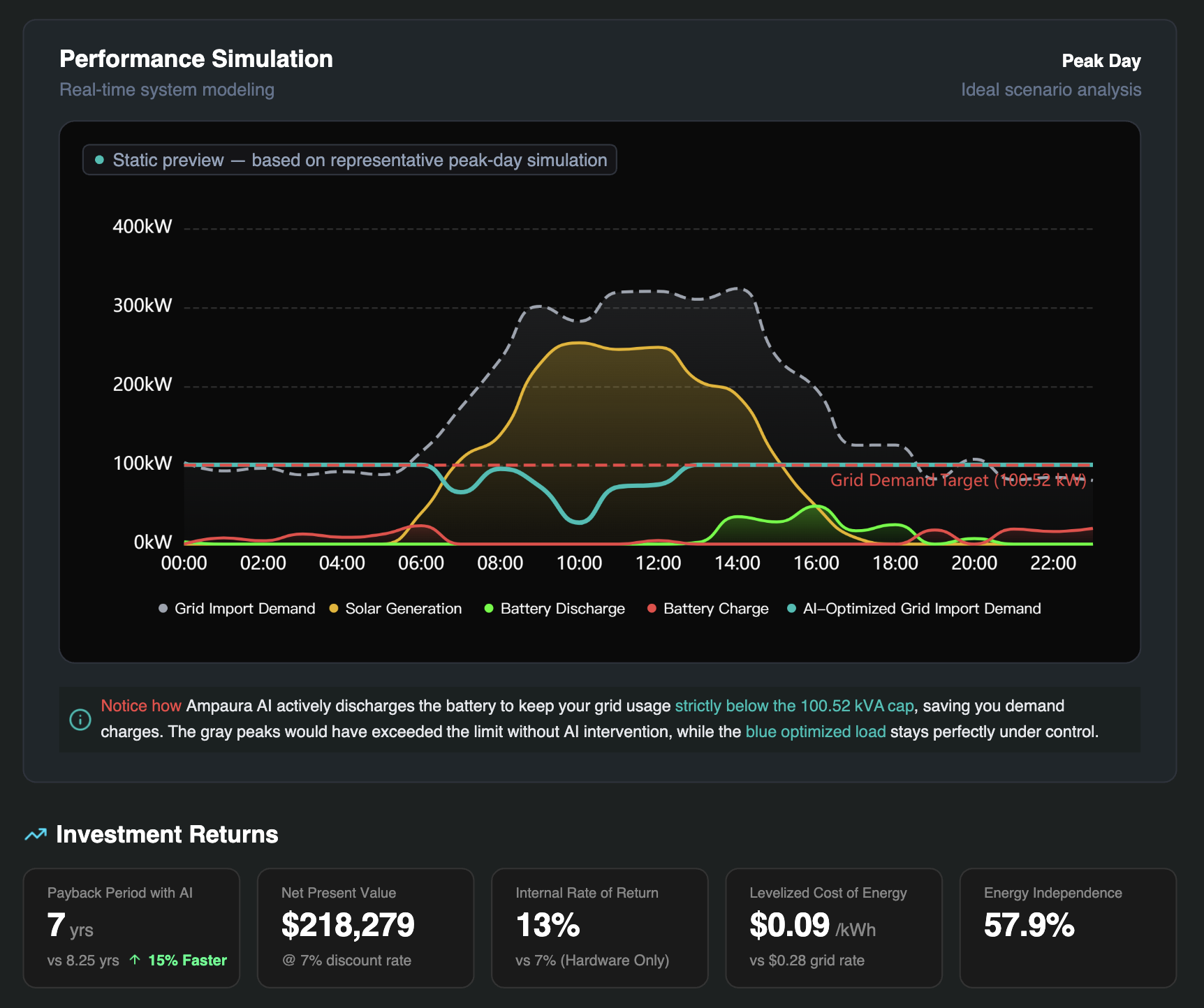
For the selected 200 kW PV and 250 kW / 522 kWh battery system, the modelled payback shortened from 8.25 to 7 years with AI optimisation. Projected IRR was 13% versus 7% for the hardware-only comparison, while projected energy independence reached 57.9%.
Projected payback for the selected system
The hardware and future-load assumptions are the same in both modelled scenarios.
Outcome
A better balance for the next project decision.
Designer helped compare equipment choices and operating strategies before deployment. The selected scenario combined a higher projected energy-independence result with improved modelled economics, giving the team a clearer option for further site evaluation.
These are modelled project estimates, not realised operating returns. Actual outcomes depend on load, tariffs, equipment costs, operating conditions and final deployment.